This site looks better in landscape mode
Skip to content

Radically improving healthspan with a novel multifactorial approach to osteoarthritis
APPA Human Data
Three clinical trials: well tolerated, dose-related, strongest in patients with more pain
Both Phase 2 studies show one pattern. APPA was generally well tolerated, efficacy was dose-related, and benefit was greatest in patients with higher baseline pain.
- Phase 1 (UK). Safety and pharmacokinetics in healthy volunteers. APPA was safe up to 1,600 mg twice daily, and the maximum tolerated dose was not reached.
- Phase 2a (Denmark). 152 patients with knee OA, 800 mg twice daily or placebo for 28 days. In the pre-specified subgroup with nociplastic/neuropathic pain features, APPA gave a significant improvement in pain over placebo. Published in Osteoarthritis and Cartilage 2024.
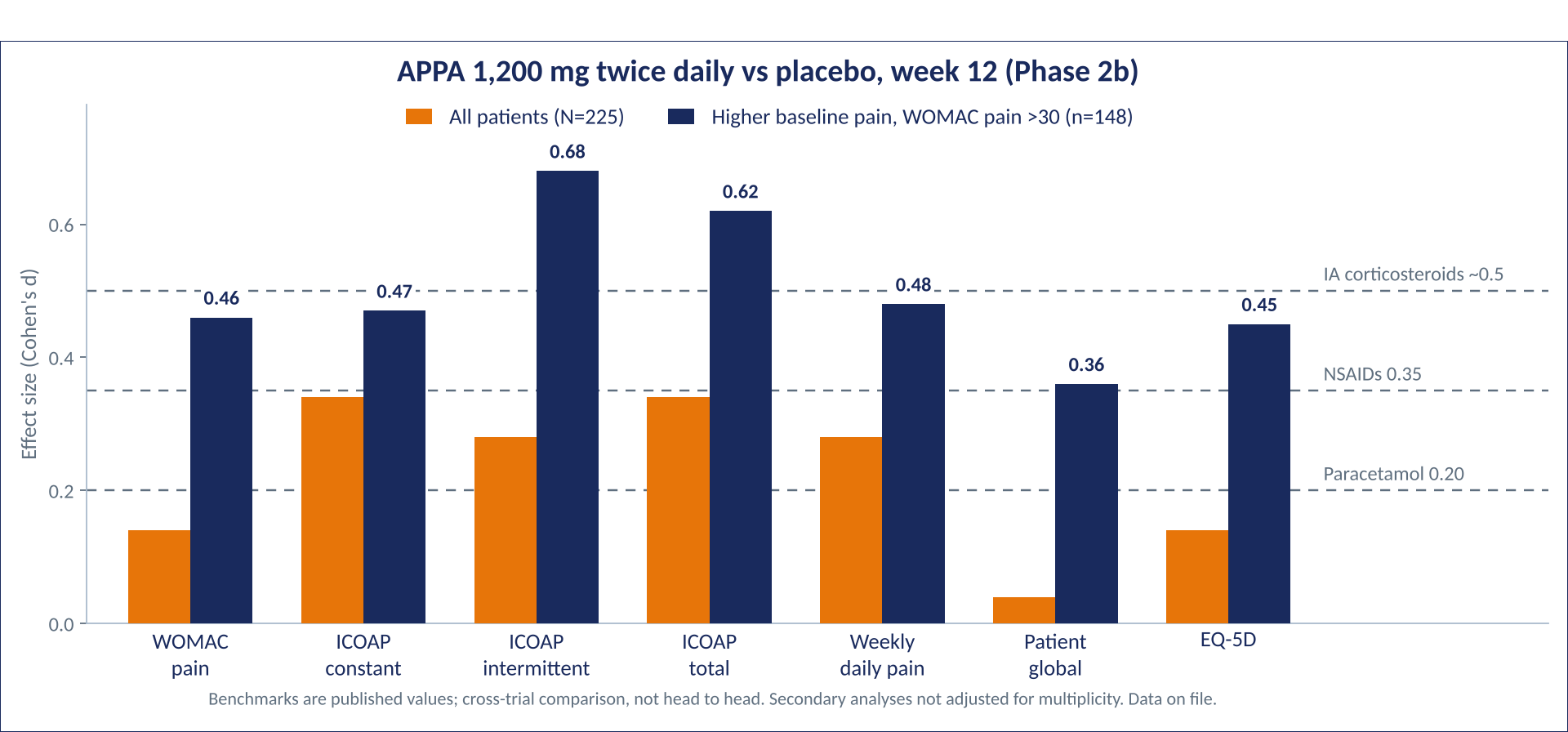
- Phase 2b (Denmark and Hong Kong). 225 patients, 800 mg or 1,200 mg twice daily or placebo for 12 weeks. Secondary outcomes, including daily pain, ICOAP pain and WOMAC function, improved with dose. In the pre-specified subgroup with higher baseline pain (WOMAC pain above 30 of 50; 148 of 225 patients), 1,200 mg twice daily gave statistically significant improvements in pain, function and responder rates. The effect size on WOMAC pain was 0.46, against published benchmarks of 0.2 for paracetamol and 0.35 for NSAIDs. Presented at OARSI 2026 and ACR Convergence 2026.
- Tolerability. Across both Phase 2 studies, at up to 1,200 mg twice daily, adverse events were mainly mild to moderate and gastrointestinal, and not dissimilar to placebo.
Case Series: in a published, uncontrolled series of 23 patients with severe, long-standing OA, 19 reported improvement (Larkins, Ann Rheum Dis 2020;79(Suppl 1):1738)
Full study data are available under confidentiality. Please contact us.
Image: APPA 1,200 mg twice daily against placebo at week 12, effect size (Cohen’s d). Dashed lines show published benchmarks; cross-trial comparison, not head to head. Secondary analyses not adjusted for multiplicity.